
3.0 KiB
DeepDive into Liquid: Part II - Asset Creation and Configuration
This is a multipart DeepDive that will focus on the Liquid Sidechain. It will be released in 3 Parts:
- Part I: Overview, Installation, and first Peg-In
- Part II (this): Asset Creation and Configuration
- Part III: Advanced Topics and Peg-out
Assets
In Part I, we succesfully Pegged-In our BTC and received L-BTC, now lets use that L-BTC to do some interesting things with Asset Issuance:
-
Let's begin by checking out these 2 commands1:
$ sudo ./scripts/app compose elements exec node elements-cli -rpcuser=$E_RPCUSER -rpcpassword=$E_RPCPASS getwalletinfo
"balance": {"bitcoin": 0.00149155}
$ sudo ./scripts/app compose elements exec node elements-cli -rpcuser=$E_RPCUSER -rpcpassword=$E_RPCPASS dumpassetlabels
{"bitcoin": "6f0279e9ed041c3d710a9f57d0c02928416460c4b722ae3457a11eec381c526d"}
This is telling us that bitcoin is a label for an asset that has the UUID of 6f0279e9ed041c3d710a9f57d0c02928416460c4b722ae3457a11eec381c526d. Everything in Liquid is an 'Asset' (including L-BTC) and each of these Assets can have different features, issuance, and restrictions.
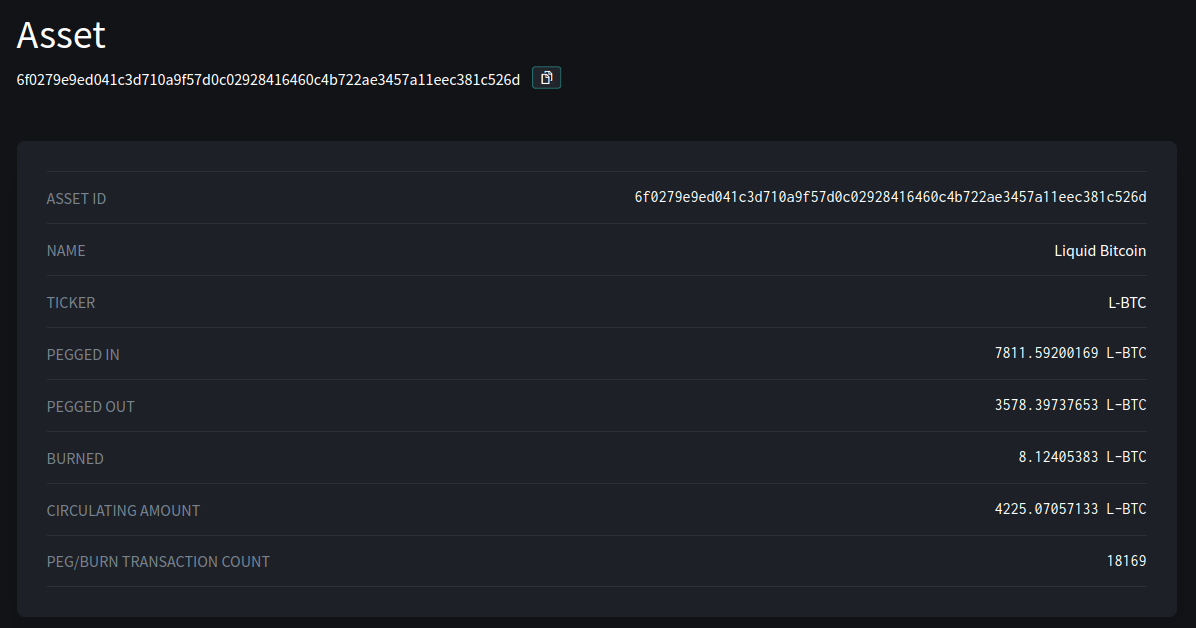
Looking up this value on https://blockstream.info/liquid/assets we can see info about it like its ticker, name, and circulating supply:
Issuing our own Asset
-
Issuing our own asset is straight-forward, as its a single line command in the client. Let's issue 10 new tokens and set the supply to be fixed (no re-issuance)
$ sudo ./scripts/app compose elements exec node elements-cli -rpcuser=$E_RPCUSER -rpcpassword=$E_RPCPASS issueasset 10 0
{ "txid": dd3983619f67e7a743ccfd32e48bbdb591c1d44b86a71d442be95a2453c0479a, "vin": 0, "entropy": cd3d7319525b28b6500d0a0b4688d91392ba8192be9bc264ec9637a001907322, "asset": 1e69f87952c26b8dfc80dda0427041a0279a0723ea12086b88b75752545e0d22, "token": 2dc5fb795fd42e08adb9dd29b5ff14f4326ecd8443e1cdc31dc6666d7576ff89 }
-
Lets set that to a variable for use later
- `$ export ISSUE='{"txid": dd3983619f67e7a743ccfd32e48bbdb591c1d44b86a71d442be95a2453c0479a, "vin": 0, "entropy": cd3d7319525b28b6500d0a0b4688d91392ba8192be9bc264ec9637a001907322, "asset": 1e69f87952c26b8dfc80dda0427041a0279a0723ea12086b88b75752545e0d22, "token": 2dc5fb795fd42e08adb9dd29b5ff14f4326ecd8443e1cdc31dc6666d7576ff89 }'
-
Now we can utilize individual entries (using
jqutility):$ echo $ISSUE | jq .asset
"1e69f87952c26b8dfc80dda0427041a0279a0723ea12086b88b75752545e0d22"
-
Checking out our wallet we see:
$ sudo ./scripts/app compose elements exec node elements-cli -rpcuser=$E_RPCUSER -rpcpassword=$E_RPCPASS getwalletinfo
"balance": {"1e69f87952c26b8dfc80dda0427041a0279a0723ea12086b88b75752545e0d22": 10.00000000,"bitcoin": 0.00148701}
-
The values E_RPCUSER and E_RPCPASS, where environmental variables we set in Part I ↩︎