
10 KiB
DeepDive into Liquid: Part III - Advanced Asset Functions, Peg-Out, Discussion
This is a multipart DeepDive that will focus on the Liquid Sidechain. It will be released in 3 Parts:
- Part I: Overview, Installation, and first Peg-In
- Part II: Asset Creation and Configuration
- Part III (this): Advanced Topics and Peg-out
Advanced Asset Topics
In Part II, we focused on issuing Assets. Now let's look at the ways you can use assets.
One of the most basic use-cases for a custom issued asset is to exchange it for something else. For purposes of discussion, let's assume that a company - say StackerNews Airline - wants to issue their clients "Air Miles" for each flight they take. The idea is clients will accrue these points and then be able to exchange them for either discounts off future flights or direct cash (ie. USD / BTC).
If we start thinking like a developer for second, this implies many things to build:
- An accounting system to manage the points
- A way to issue these points to the clients, who themselves would need some a way to store and manage their points
- Middleware to handle the exchanging of points for cash
- Security? How do we secure this? How to reduce fraud as much as possible?
Sure, Stacker News could just do all this themselves using SQL, but lets assume that since they were clever boys & girls, they wanted to do as little of the hard work as possible.
Liquid would make a great solution for this case. They could simple direct their users to download one of the existing Liquid wallets1 and use the Liquid sidechain as the "accounting system" for their asset.
Atomic Swaps
In this case, let's suppose our Customer has earned 1 SND token (which for our purposes is our pretend airline mile token) and now he wants to exchange that for L-BTC. How do we do that?
We could build some type of typical web-stack of NodeJS / SQL that would accept Asset A and then issue Asset B once received...however as we said our StackerNews crew is smart and therefore prefers to do less hard work. Moreover all of the above lends itself to risk of fraud and counterparty default.
Luckily, due to the additional OPCODEs in Liquid, Atomic Swaps are supported2. In fact, Blockstream has a tool to simplify using it3.
To do a swap we will need another wallet, as you can't swap between the same wallet (technically you can use the same node and use 2 different wallets on that node4). In my case, I have 2 nodes each running their own elementsd server (Umbrel and my desktop). So I will use those, but you can use a single node by setting up multiple wallets and using distinct URL connect strings for each.
Before we start, let's look at state of our 2 wallets:
#Node1 - StackerNews Airline, Inc.
"balance": {
     "bitcoin": 0.00131755,
    "3e62af3c80c56ab6fec3d1e5646637152afebaf2a86ace075bbb7a88702e1fe5": 8.00000000
  }

#Node2 - The Customer
"balance": {
    "bitcoin": 0.00010623,
    "3e62af3c80c56ab6fec3d1e5646637152afebaf2a86ace075bbb7a88702e1fe5": 1.00000000
  },
The Blockstream Liquid Swap tool mentioned previously works both in CLI and GUI mode. So for this example we will use CLI for Node1 and GUI for Node 2. The swap offer proposal is: StackerNews Airline (Node 1) is willing to accept a SND token and return to the client 2,300 sats (approx $1 USD currently). So Node1 makes the following proposal:
# Node 1 - StackerNews Airline, Inc.
$ liquidswap-cli -u http://$E_RPCUSER:$E_RPCPASS@localhost:7041 propose -o proposal.txt 3e62af3c80c56ab6fec3d1e5646637152afebaf2a86ace075bbb7a88702e1fe5 1 6f0279e9ed041c3d710a9f57d0c02928416460c4b722ae3457a11eec381c526d 0.000023
This file was exported to proposal.txt and transferred to Node2 (the customer), which was then inspected:
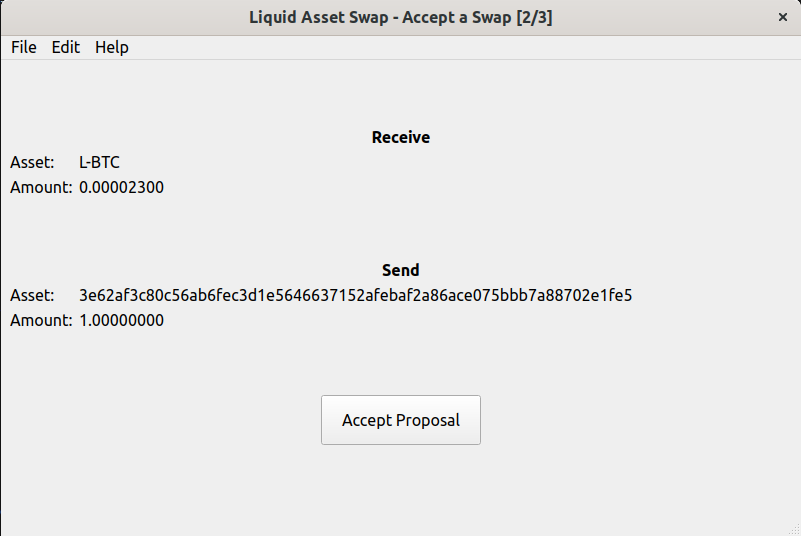
We can see that this proposal matches our expectation (1 SND token in exchange for .000023 L-BTC). So Node2 accepts the proposal:
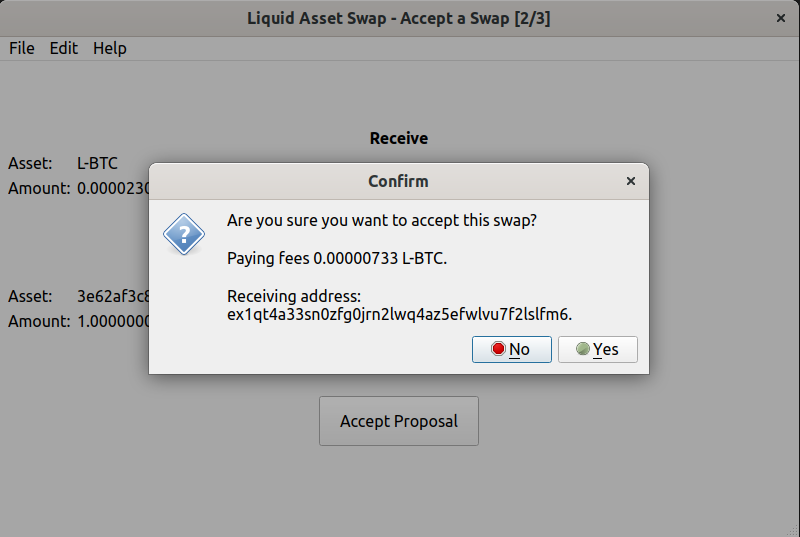
The export accepted.txt file is transferred back to Node1 where it is finalized and sent.
# Node 1 - StackerNews Airline, Inc.
$ liquidswap-cli -u http://$E_RPCUSER:$E_RPCPASS@localhost:7041 finalize accepted.txt -s
{
    "broadcast": true,
    "txid": "e427ff20ee93b5c9fef74031492357f3fcb535ec834f2035918008d3de406808"
}
Now lets review the state our wallets post swap:
#Node1 - StackerNews Airline, Inc.
"balance": {
    "bitcoin": 0.00129180,
    "3e62af3c80c56ab6fec3d1e5646637152afebaf2a86ace075bbb7a88702e1fe5": 9.00000000
  }


#Node2 - The Customer
"balance": {
    "bitcoin": 0.00012656
  },
| SWAP SUMMARY | Node 1 (Stacker News) | Node 2 (The Customer) |
|---|---|---|
| Pre-Swap: SND | 8 | 1 |
| Post-Swap: SND | 9 | 0 |
| Pre-Swap: L-BTC | 131755 sat | 10623 sat |
| Post-Swap: L-BTC | 129180 sat | 12656 sat |
| TOTAL FEES PAID | 251 sat | 291 sat |
(NOTE: Obviously the workflow here is a little clunky with the back-and-forth Proposal/Accept/Finalize routine, but I wanted the steps to be transparent. In a production case this would be built into the service and client app such that the proposal and acceptance strings were automatically transferred between the parties.)
Securities / Transfer Restricted / etc
Liquid supports more advanced features than just Swaps. These features involve the use of AMP (Asset Management Platform). This is an API that allows users to issue and manage digital assets on the Liquid Network.
Here are some of the features AMP enables
| Asset Type | Description |
|---|---|
| Tracked Asset | Movement of assets are tracked by AMP. Even though the movements of the Asset are secured within Confidential Transactions (and thus private on the chain), the issuer can see. Ownership can be queried via point-in-time. |
| Transfer Restricted Asset | In addition to all the above features, once an asset is issued to a user, they are restricted from transferring it without specific approval from Issuer. Asset transfers are restricted based on user Categories. So for example you could create a Category of user named Stacker News User and restrict transfer of these assets only among that group |
By using one of the above concepts, this means AMP can be used in the following use-cases:
- Asset Holder Registry - Since AMP is notified of transfers, so it makes it possible for the Issuer to always know "who has what". Thus, although everything is confidential on the public blockchain (and even among the asset holders), the Issuer can still have visibility into this.
- Share / Ownership Vetting - Because point-in-time moves can be queried, its possible for the Issuer to calculate "how long has User A owned this asset". This enables concepts like "share vetting" (ie. you can only sell your shares after holding for 365 days)
- Paying Dividends - Since you can calculate point-in-time ownership, this makes it possible to use these assets to pay dividends (say for instance your company was to pay .01 BTC in dividends this month, and you calculated that User A held a share for 10 days and User B for 20 days. Thus, you could pay User A .0033 L-BTC and User B .0066 L-BTC)
Lightning Integration
There are two separate topics to go over with Lightning <-> Liquid. First is L-BTC Lightning (that is LN as a 2nd layer to Liquid). Secondly, the more familiar, using regular BTC LN with Liquid.
Using Liquid with BTC / LN
What if you have no desire to create tokens, securities, etc...can you still make use of Liquid?
Yes, probably one of the best ways to do that is to use it as a staging area for opening Lightning channels. In fact, both Blockstream Green and the newly announced (more user friendly) AQUA both do that under-the-hood. They are using services like Boltz, which allows you to open Lightning Channels with L-BTC.
Comparing eCash / Lightning / Liquid / BTC
| eCash | Lightning | Liquid | BTC | |
|---|---|---|---|---|
| UTXO Model: | No UTXO. Bearer token | Your UTXO is in a multisig. | You own UTXO in sidechain | You own UTXO in mainchain |
| Redemption: | Depends on mint | No dependency (might require fee) | Depends on Federation | No dependency |
| Longevity: | Mint must survive | Channels will close at some point | Federation must survive | UTXO forever |
| Online: | Must be online to verify eCash token | You must be online to receive. You must stay online (or hire watchtower) to secure channel state | Offline receive | Offline receive |
| TXN Time: | Instant transactions | Instant transactions | Fixed 2 min transactions | Variable ~10 min transactions |
| Fees: | No fees | Negligible fees (msat) | "Low" fees (~200 sats) | High fees (~15,000 sats) |
| Liquidity: | No liquidity management | Must manage liquidity (in/out) | No liquidity management | No liquidity management |
| Privacy: | Mints can aggregate and assemble transaction data | Nodes could aggregate and assemble transaction data | Confidential transactions | Absolute public ledger |
| Federation: | Must vet each Mint | You choose channel partner | Known federation members | Sovereign |
| Frac Reserve Possible: | Yes | No | Verifiable Issues | No |
| Likely Threat: | Debasement or Mint rug | Theft of funds while offline | Federation censorship | Losing keys / non-spendable UTXO for fees |
| Maturity: | 2023-2024 | 2018 | 2018 | 2009 |
Building Your Own Federation
Pegging Out
Final Discussion and Ideas
-
BlockStream Green, AQUA, Anser (web wallet), Specter, Marina (web wallet) ↩︎
-
Atomic Swaps allow parties to exchange different tokens directly without the need for a 3rd party, eliminating most of the risk of fraud and counterparty default.In fact, Blockstream has a tool to simplify using it. ↩︎
-
Please
git clonethe repo and don't rely on the pre-compiled downloads in repo (they are out of date from source) ↩︎ -
You can specify to individual wallets in the swap-tool URL connect string by using the
http://user:password@localhost:7041/wallet/walletnamesyntax ↩︎